UX Design Projects
Redesigning how users decide what to cook on a daily basis almost three times a day
My role: UI/UX Designer
Timeline: Apr 2024 - May 2024
Visit Website
Problem Statement
People often have frustration when it comes to deciding and coming up with meal options everyday.
But how can we make the decision making process easier and fun filled ?
User research
Secondary user research revealed various insights about the challenges people face when it comes to deciding what to cook, some of which are mentioned along with sources.
Decision Paralysis: A study revealed that adults spend approximately 23 days annually making decisions, with 58% experiencing 'decision paralysis' over trivial matters, including meal choices.
"The most common decision – what to eat for dinner – was also voted the one people are most bored with making (39 percent)."
Source: https://www.thesun.ie/fabulous/13651727/decision-making-oreo-clattenburg-regret-decide
Desire for Variety vs. Routine: While some find comfort in eating the same meals daily, experts emphasize the importance of dietary diversity for optimal nutrition, adding complexity to meal planning.
"Experts say that eating the same meals over and over again may fuel anxiety and lead to nutrient deficits."
Source: https://www.health.com/eating-same-food-daily-8687498
Planning behaviors: Only 24% of families plan meals more than 3 days in advance, while 61% decide on the day what to cook for dinner.
"Moreover, 55% report having the same 10–12 meals in rotation, indicating a lack of variety and planning."
You can find one of the interviews conducted by Better Homes & Gardens Magazine here: https://www.bhg.com/dinner-diaries-mom-rural-iowa-7557518
User interviews
User interviews revealed that the process of thinking or coming up with a menu for the day almost three times a day minimum, everyday throughout their life was more difficult than the cooking process itself.
Competitive Analysis
Competitive analysis revealed that existing solutions are not comprehensive and intuitive.
While there are solutions like meal planners in the market, they do not address the time constraint issues users face.
Design intent
Our primary goal is to reduce the burden of deciding what to cook while also making it enjoyable.
How ?
How might we make the user interface intuitive and controllable for the users ?
How might we enhance user experience ?
How might we make the process enjoyable ?
Logo Design

GENERATE
GENERATE
The Final Logo Design with custom typography and fry pan conveys the blend of casual, fun approach to cooking and meal planning.
Typography
H1 Title 48px
P1 Body text 20px
Colors
PRIMARY
#E84500
#2B2D31
SECONDARY
#97BE80
#B74B4B
WHITE
#FFFFFF
BLACK
#191A1C
Challenges
There were technical and budget constraints, some of which are mentioned below:
The option to choose the complexity of making a dish like quick and easy to make dishes, rich and complex dish etc catering to users of a whole different spectrum like office goers, home makers, bachelors etc., was not implemented in the MVP due to technical and time constraint.
Feedback & Iterations
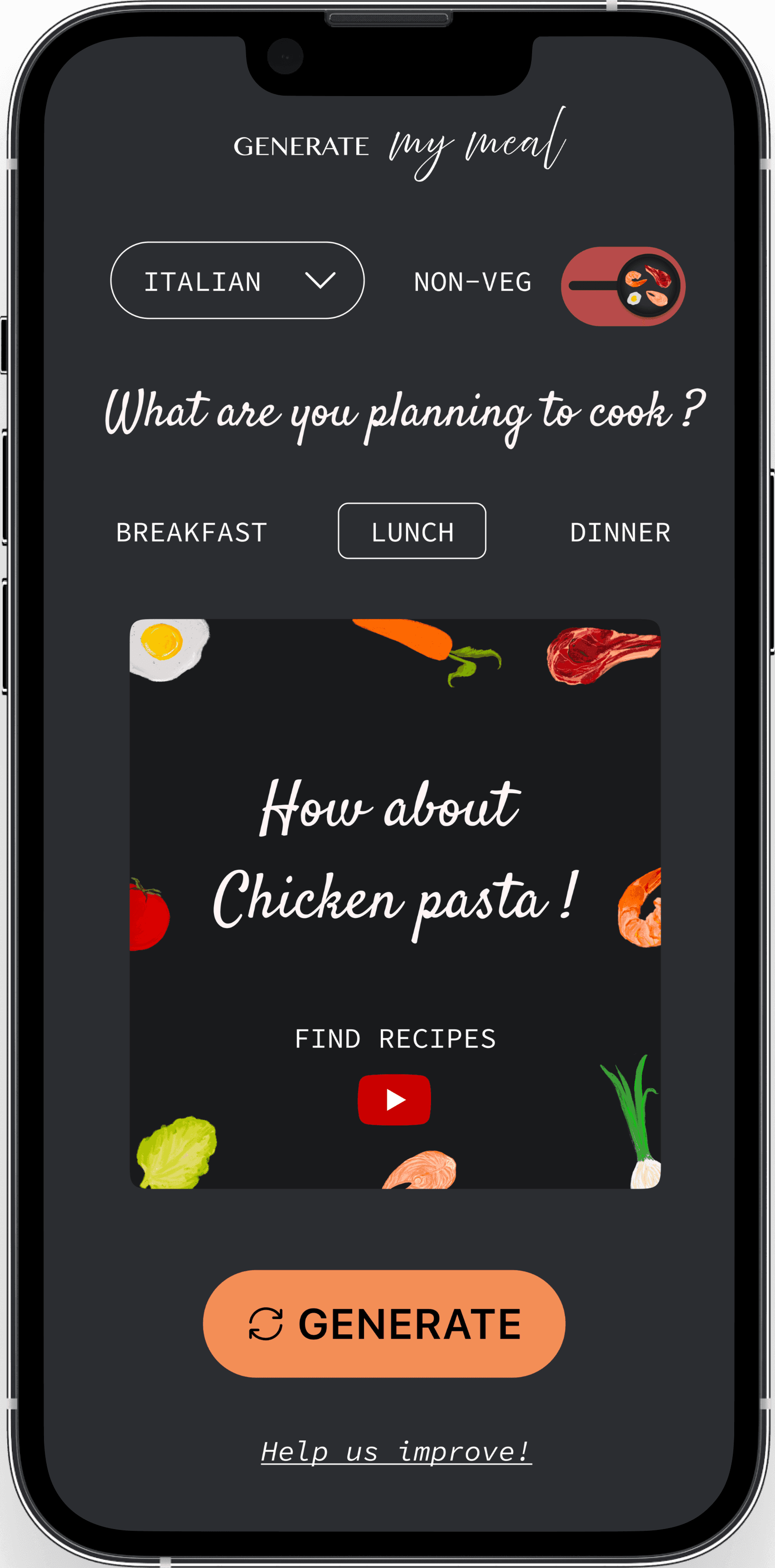
Based on user testing the veg/non-veg button was given a text label as few users faced difficulties in understanding the use of the button.
Key features implemented
Some of the user-centric features designed are as follows :
The website is single page and responsive, the entire website is within the ATF area thereby making users feel at ease.
Customizing the meal generation is one of the major key feature where users can set preferences of cuisines like Italian, Korean etc., diet choices like vegetarian, vegan etc.,
The option to view recipe videos for the generated meal option is a key feature that enable users to quickly view and start cooking.
Key performance indicators
Users spend less than 1 min to generate a meal of their preference
About 90% of users complete the meal generation process successfully
Learnings
Most important takeaways are
Designing with simplicity for a product to be used on a daily basis makes a positive impact on people’s lives.
Launching the product in real world and iterating on a regular basis is the key to a user-centric product design.
Next steps
Updating the existing database of the meal options through extensive user research about homemade food in different cultures and regions is the next area of focus, as it is critical to offer various options for a vast set of people all across the globe.